

Black Chip Poker in 2026: Venom, Sun Run and Final Table Streams
Black Chip Poker’s 2026 tournament calendar is built around two very different kinds of series. Venom remains the high-buy-in headline event, with multi-million-dollar guarantees, mystery bounties and long qualification campaigns. Sun Run, by contrast, was designed for small- and mid-stakes tournament players who wanted a concentrated summer schedule without committing four figures to a single entry. Both series are available through the Black Chip Poker client because the room is part of the Winning Poker Network, so players share the same major tournament fields with users of other network brands. The other notable part of the 2026 offer is the continued use of delayed final-table broadcasts, which allow viewers to see hole cards without giving active players immediate strategic information. Taken together, these elements show what Black Chip Poker is prioritising in 2026: large shared fields at the top end, affordable festival schedules below them and more visibility for the final stages of major online tournaments.
The 2026 Venom Schedule and the Move to Dual Mystery Bounties
Venom did not appear only once in 2026. Black Chip Poker players had access to dual No-Limit Hold’em and Pot-Limit Omaha Mystery Bounty editions early in the year, each carrying a $2,650 direct buy-in. The January running offered an $8 million guarantee for the Hold’em event and $2 million for the Omaha event. The Hold’em field produced 3,673 entries and a prize pool of $9,182,500, comfortably above the guarantee. The official champion, “MatasSembolas”, received $630,328 after a three-way deal and added $97,953 in mystery bounties. A further dual edition followed in April. Its Hold’em tournament drew 3,233 entries for $8,082,500, while the Omaha event attracted 871 entries and created a $2,177,500 pool. These figures matter because they show that Venom in 2026 is no longer a single annual tournament. It is a recurring high-value format that can exceed its posted guarantees, although a future edition can never be assumed to do the same.
The main 2026 summer edition is scheduled from 13 August to 2 September and has been announced with $15 million in combined guarantees. The No-Limit Hold’em Mystery Bounty Venom accounts for $12 million of that figure, while the Pot-Limit Omaha version carries a $3 million guarantee. Both retain the $2,650 buy-in. Each tournament has eight Day 1 flights on 13, 16, 17, 20, 23, 24, 27 and 30 August, all scheduled for 12:05 p.m. Eastern Time. Day 2 is set for 31 August at 1:05 p.m. Eastern Time, when qualifying players enter the money and mystery bounties become active. The Omaha event is due to finish on Day 2. Hold’em continues to Day 3 on 1 September, with its final table scheduled for 4:05 p.m. Eastern Time on 2 September. Players outside North America should convert these times carefully because daylight-saving differences can affect the local start time.
The bounty structure changes the value of simply reaching Day 2. In the announced summer events, every knockout from Day 2 is due to produce a mystery bounty worth at least $5,000. The largest possible bounty is listed at $500,000 in Hold’em and $250,000 in Omaha. This means a player can secure a significant return without reaching the last table, but the bounty element should not be mistaken for guaranteed profit. A qualifying stack still has to eliminate an opponent before any bounty is drawn, and the value remains unknown until the draw is made. Black Chip Poker also states that players may enter more than one Day 1 flight and combine qualifying stacks for Day 2, provided they use the same Winning Poker Network account. The rule creates flexibility, but it also makes total spending harder to judge if a player repeatedly re-enters. Deal-making is permitted at the final table, while the room reserves the right to adjust terms within a reasonable period before the event.
Entering Venom Without Treating It as a Single $2,650 Bet
The direct buy-in is only one route into Venom. During 2026, the network has used several satellite formats, including direct qualifiers, mega satellites, Beast tournaments, Survivor Flip steps and low-cost paths beginning at $0.80. The summer Venom Fever campaign has been advertised with more than 1,500 guaranteed seats across its qualifying schedule. For a player with a modest tournament bankroll, these routes are more realistic than paying $2,650 at once, but they still require a spending limit. A satellite chain can feel inexpensive because each individual entry is small. Several failed attempts, re-entries and last-minute qualifiers can nevertheless add up to an amount that would have been unacceptable as a direct tournament fee. A sensible approach is to decide the full qualification budget in advance, record every attempt and stop when that figure is reached. Winning a seat cheaply is valuable; chasing one without a limit turns a discounted route into an uncontrolled expense.
The eight-flight structure also needs a plan. Combining stacks can reward a player who qualifies more than once, because chips earned in separate Day 1 flights are added before Day 2. That does not mean every successful qualifier should automatically play again. A strong first stack may already provide enough room to begin Day 2 with patience, whereas another $2,650 entry or a long run of satellites may offer poor value compared with protecting the bankroll for other events. Players should also check the tournament lobby before registering, as the lobby contains the current blind structure, late-registration period and any schedule changes. Internet reliability matters as well. Winning Poker Network tournament rules place the normal risk of a personal disconnection on the player, who continues to receive cards and pay blinds while offline. For an event lasting several days, a stable connection and a backup option are practical preparation rather than minor conveniences.
Once Day 2 begins, the format creates decisions that differ from a standard freezeout. The minimum $5,000 bounty can make an opponent’s short stack especially valuable, but a large stack should not call every all-in simply because a bounty is available. The chips lost in a poor call can reduce access to later knockouts, higher payouts and the final table. The unknown top prizes also produce emotionally difficult moments: a player may see somebody else draw a six-figure bounty from an ordinary elimination, yet that result does not change the quality of the next decision. The clearest way to approach the format is to separate what is known from what is random. Stack sizes, position, payout stages and the strength of a hand can be assessed. The bounty hidden behind an elimination cannot. Venom rewards players who recognise the extra value of knockouts without allowing the mystery draw to dominate every choice.
Sun Run as the Lower-Buy-In Counterpart to Venom
The Sun Run Series ran from 14 to 28 June 2026 with $2,186,000 in advertised guarantees. Its schedule was aimed at small- and mid-stakes players rather than the high rollers targeted by Venom. That distinction was visible in the featured buy-ins, which extended down to micro-stakes events while still including six-figure guarantees. Sun Run therefore served a different purpose within the same tournament calendar. It gave regular players a two-week festival with repeated chances to play, rather than concentrating almost all value in one expensive Main Event. The schedule included conventional multi-table tournaments, progressive knockouts, jackpot-branded events and multi-flight competitions. For players reviewing the series after it ended, the useful point is not merely the total guarantee. The more important feature was the spread of entry costs, which allowed a player to choose a level that matched an established bankroll instead of using satellites as the only affordable route into a major festival.
The final Sunday on 28 June contained three Main Events at clearly separated price levels. The largest offered a $200,000 guarantee for a $66 buy-in. A $27.50 event carried a $100,000 guarantee, while the $6.60 version offered $20,000. The series also included three main multi-flight progressive knockout tournaments that began before the official two-week window and continued towards the final day. These were a $300,000 guaranteed event at $66, a $75,000 event at $22 and a $50,000 event at $5.50. The multi-flight format gave players more than one opportunity to qualify for the next stage, while the knockout element returned part of the prize value through eliminations. Even at these lower prices, repeated entries could increase the real cost quickly. The advertised buy-in should therefore be read as the cost of one attempt, not the likely total for somebody who plays several flights or re-enters multiple events.
Sun Run’s practical strength was schedule density rather than a single record-sized prize pool. A player could build a personal programme around a few selected events, while somebody with more time could pursue daily volume. That flexibility also created a risk: festival lobbies encourage players to register for overlapping tournaments simply because another event is always starting. Before playing several tables, it is worth considering how many decisions can be handled accurately at once and how late each tournament may run. A $6.60 or $11 entry is still poor value when fatigue leads to rushed calls or missed action. The series was also useful as preparation for larger multi-day events because it included progressive knockouts and multi-flight structures similar to those used in Venom. It did not reproduce Venom’s pressure or prize scale, but it offered a lower-cost setting in which players could learn how they manage long sessions, repeated starting flights and bounty decisions.
The Sun Run Leaderboard and Its Connection to Venom
Black Chip Poker attached $15,500 in extra prizes to the 2026 Sun Run leaderboard. First place was advertised with a $2,650 Venom ticket and $2,500 in cash. Second place offered the same Venom ticket plus $1,000, while third place received a $2,650 ticket. Fourth and fifth were due $1,500 and $750 respectively, and positions six through ten each received tournament-ticket packages valued at $360. The top three rewards created a direct link between the lower-buy-in summer festival and the high-stakes Venom schedule. A player could therefore reach the flagship event through consistent series results rather than one satellite victory. The leaderboard prizes were added to normal tournament payouts, so a deep run could contribute both immediate cash and ranking progress. However, only ten positions earned a prize, making it important to distinguish a possible bonus from money that should be included in an expected return.
A leaderboard can change how players choose events, sometimes in unhelpful ways. Someone close to a prize position may reasonably add a tournament that fits the remaining budget and schedule. Someone far behind should be cautious about increasing volume solely to chase points. The extra buy-ins are certain, while the final leaderboard reward is not. The official standings should be checked during the series because the value of another entry depends partly on the points gap, the events still available and the likely activity of competing players. It is also important to read the published scoring and eligibility rules rather than assuming that every tournament awards identical points. A good series plan treats the leaderboard as secondary. Tournament selection should first make sense on buy-in, format, timing and personal performance; ranking points can then improve the value of a decision that was already reasonable.
The strongest connection between Sun Run and Venom is progression, not a promise that one series will finance the other. Sun Run gives players lower-cost access to the same shared network fields and some of the same tournament formats. A player can use those events to judge whether they remain focused through long late-registration periods, whether progressive knockouts affect their decision-making and whether several starting flights lead to disciplined choices or unnecessary spending. A Venom ticket from the leaderboard would be a major result, but even without one, the series can provide useful evidence about readiness for a larger event. Players who struggle to control entries or session length in a $5.50–$66 schedule should address those issues before pursuing a $2,650 tournament. Moving up responsibly means increasing the buy-in only when the bankroll, schedule and quality of play support it.
How Black Chip Poker Final Table Streams Work in 2026
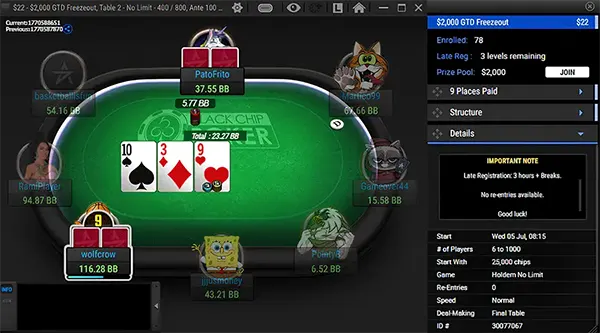
Black Chip Poker offers delayed cards-up coverage for selected final tables, including Venom. The official viewing method is built into the poker client. A viewer logs in, opens the relevant tournament lobby and looks for the streaming box; if coverage is available for that event, the stream can be launched from there. Hole cards are shown with a 30-minute delay rather than in real time. This is an important distinction because a live cards-up feed could give active players or outside helpers information about recent strategy while the tournament is still in progress. The delay reduces that risk while preserving most of the value for viewers. It also means that social-media updates, lobby results or messages from players may reveal an elimination before it appears on screen. Anyone who wants to watch without spoilers should avoid real-time result feeds until the broadcast catches up.
Not every final table is guaranteed to receive the same production. Black Chip Poker describes the feature as available for selected tournaments, so the presence of the in-client streaming box is the most reliable event-specific confirmation. Major Winning Poker Network final tables have also appeared on ACR Poker’s public broadcast channels, sometimes with commentary, but the exact external destination can change from one series to another. For the August 2026 Hold’em Venom, the official schedule places the final table at 4:05 p.m. Eastern Time on Wednesday, 2 September. Viewers should check the tournament lobby and current event page close to the start rather than relying on an old bookmark or a previous Venom broadcast link. A delayed stream may begin later than the listed table start because the production has to maintain the security gap before showing cards.
Cards-up coverage is more informative than ordinary rail viewing because the audience can compare actual holdings with the actions taken. It is still not a complete record of everything influencing a decision. Viewers may not know a player’s recent history with an opponent, physical circumstances away from the computer, time-bank position or private preparation. Commentary can explain stack pressure and alternative lines, but it should not be treated as proof that one decision was the only correct choice. The most useful way to watch is to pause mentally before the cards are revealed, consider what ranges each player might hold and then compare that expectation with the showdown information. This turns the broadcast into a study session rather than passive entertainment, while keeping in mind that one final table is a small sample and unusual results are common in tournament poker.
What Viewers Can Learn from a Venom Final Table
The first detail to track is effective stack size: the smaller of the stacks involved in a hand. A player may appear to have a huge chip lead, but a decision against another large stack can still put most of that advantage at risk. Short stacks face a different problem because waiting too long allows blinds and antes to reduce their ability to force folds. At a Venom final table, prize jumps add further pressure, and mystery-bounty money may already have created very different total returns for players sitting in similar payout positions. Watching how often leaders attack medium stacks, how short stacks choose their all-in spots and how players respond to pay jumps provides more value than focusing only on spectacular bluffs. The purpose is not to copy a single move, but to understand why the same hand can be played differently when stack distribution and payout pressure change.
Bet size and timing are also worth recording in plain language. Note when a player uses a small continuation bet, when a turn is checked through and when a river bet places an opponent under maximum pressure. Then compare those choices with the revealed cards. Over several hands, patterns may become visible: a player may use the same size with strong hands and bluffs, or may reduce aggression against another large stack. The 30-minute delay makes it possible to see these patterns without affecting the live contest. Viewers should still resist judging a player solely by the result of one hand. A bluff can be well chosen and still be called; a loose call can win after hitting a fortunate card. Good analysis asks whether the decision made sense with the information available at the time, not merely whether the pot moved in the player’s direction.
The final broadcast also provides a useful check on the event information shown elsewhere. The lobby displays the remaining players, current payouts and blind level, while the stream supplies the narrative of how those numbers change. For the 2026 summer Venom, viewers should confirm the final-table time, stream availability and any revised terms shortly before 2 September, as Winning Poker Network rules allow schedules for major events to be adjusted when necessary. Players planning to compete should use the stream only after their own participation has ended and follow the network’s rules on outside assistance and real-time advice. For everyone else, the delayed feed offers a clear view of the decisions that decide one of Black Chip Poker’s largest tournaments of the year. Its real value lies in showing how experienced players handle pressure, uncertainty and large pay jumps hand by hand.